
More than three-quarters (77%) of Millennial parents believe their children are more influential in determining purchases than they were to their own parents.
Generational Influence Is Reshaping Household Decision-Making
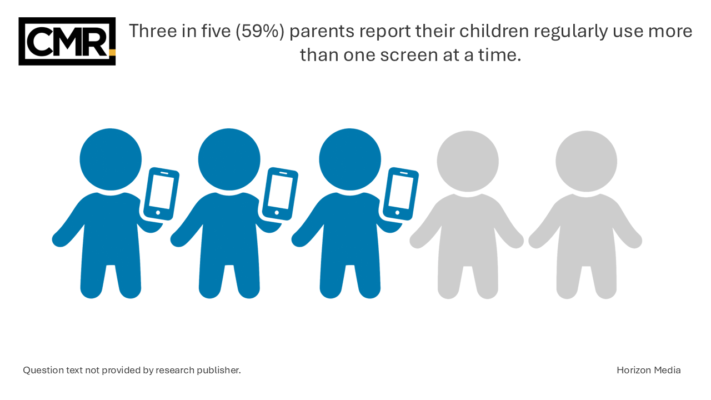
Millennial parents, having grown up as the first digital natives, now find themselves navigating a new era of influence led by their Gen Alpha children. More than three-quarters (77%) of Millennial parents believe their children are more influential in determining purchases than they were to their own parents, highlighting a generational inversion in buying power and cultural leadership within the household. At the same time, just under three-fifths (59%) of parents report that their children regularly use more than one screen at a time, suggesting that Gen Alpha is developing habits shaped by immersive, multitasking environments from an early age.
Shared Interests Are Replacing Algorithmic Discovery
The dynamics of media discovery are also shifting. A majority (82%) of respondents say content is now discovered through shared interests, not just algorithm-driven personalization. As consumers, both parents and children are placing increasing importance on relevance over reach with three-quarters (76%) saying content relevance is more important than creator popularity when determining influence. These changes could indicate a move away from purely viral content toward more personally meaningful media experiences that spark community engagement and emotional resonance with viewers.
Nostalgia and Social Play Are Central to Engagement
As families seek out shared media experiences, nostalgia has become a powerful unifier, more than four-fifths (84%) of respondents say they gravitate toward familiar, nostalgic formats when building shared moments. Additionally, gaming environments are evolving into primarily social platforms, with four in five (80%) respondents agreeing that gaming is now more about interaction than gameplay itself. Together, these findings could point to a growing cultural shift where media and brand engagement are increasingly built around collective experiences and intergenerational connections, not just solitary consumption or algorithmic targeting.
Read more
Research publisher
Horizon Media, the largest independent media agency globally, delivers data-driven business outcomes for some of the most innovative and ambitious brands. Founded in 1989, headquartered in New York, and with offices in Los Angeles and Toronto, the company employs 2,400+ people and has media investments of more than $8.5 billion. Horizon Media’s fundamental belief is that business is personal, which drives its approach to connecting brands with their customers and engaging with its own employees, resulting in industry-leading workplace satisfaction levels (Glassdoor). The company is consistently recognized by independent media outlets for its client excellence and has earned several “Best Workplaces” awards reflecting its commitment to DEI and the life and well-being of everyone at Horizon Media.
Methodology
The WHY Group and Blue Hour Studios conducted a comprehensive analysis combining cultural audit and social listening with primary research. The audit analyzed 250+ pieces of content to identify emerging narratives and patterns. Findings were validated through proprietary research using a panel of 1,000 American Millennial parents (ages 28-48) with Gen Alpha children (ages 7-13) in February 2025. The research team also conducted qualitative in-depth interviews with both parents and children to provide deeper context for quantitative findings. The WHY Group and Blue Hour Studios translated these insights into actionable brand directives.
